
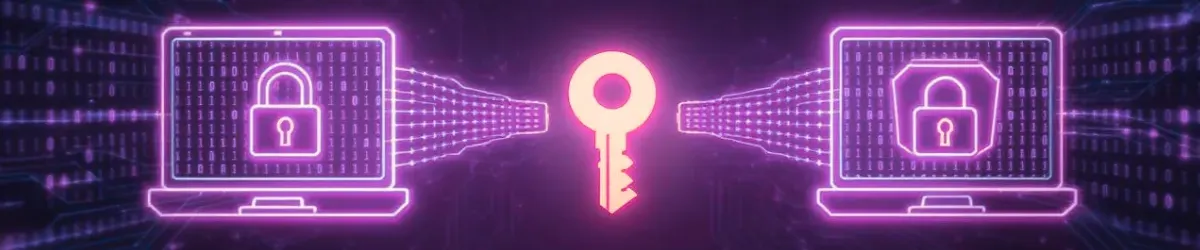
Symmetric encryption plays a crucial role in safeguarding data, ensuring only authorized parties can access sensitive information. Understanding how it works is essential for anyone interested in cybersecurity, networking, or data privacy. This guide covers what a symmetric encryption algorithm is, how it works, practical use cases, common examples, its advantages and limitations, and best practices for beginners and aspiring professionals.
What Is a Symmetric Encryption Algorithm?
A symmetric encryption algorithm uses the same secret key for both encrypting and decrypting data. That means the sender and the recipient must possess identical keys, which makes the process fast and efficient. Picture a box with a special lock, where you and a friend both hold the same key — you put a message inside and lock it, and your friend uses that exact same key to open the box and read it.
Because only one key is involved, both parties must have identical copies of it, and keep it safe from anyone else. If the key falls into the wrong hands, that person can both read messages and forge new ones that appear legitimate.
One of the biggest advantages is speed. Since it uses a single key, the process requires fewer computing resources, making it much faster than an asymmetric encryption algorithm, which relies on two keys (a public key and a private key). This efficiency makes symmetric algorithms ideal for encrypting large amounts of data quickly — files, databases, or communication between systems.
There’s one challenge, though: key sharing. Before secure communication can begin, the secret key has to be exchanged between the parties in a secure way. If someone intercepts it during that exchange, they can access the encrypted data — which is why symmetric encryption is often combined with other techniques for safe key distribution.
Popular symmetric algorithms include AES (Advanced Encryption Standard), DES (Data Encryption Standard), and Blowfish — all widely used to protect sensitive information across a range of applications.
Core concepts and terminology
- Plaintext — the original data or message in its readable, understandable form. Before encryption, all information — text, files, communication — is considered plaintext.
- Ciphertext — after encryption, plaintext is transformed into ciphertext, a scrambled, unreadable format. Without the correct key to decrypt it, ciphertext appears as random noise.
- Key — the secret value that both encrypts plaintext into ciphertext and decrypts ciphertext back to plaintext. Since the same key does both jobs, keeping it secure is essential to maintaining data privacy.
- Block cipher — encrypts data in fixed-size blocks, such as 64 or 128 bits, processing one block at a time. AES and DES are both block ciphers, and typically use specific modes of operation to securely encrypt data larger than a single block.
- Stream cipher — unlike block ciphers, stream ciphers encrypt data one bit or byte at a time, making them well-suited to continuous data streams such as secure voice or video communication. Examples include RC4 and Salsa20.
A popular example: AES
One of the most well-known and widely trusted symmetric algorithms is AES (Advanced Encryption Standard). It encrypts data in fixed-size blocks (commonly 128 bits) using a shared secret key that both sender and receiver possess.
AES has become the global standard for protecting sensitive information because it offers a strong balance of security, speed, and efficiency. Governments use it to secure classified data, financial institutions rely on it for transactions, and everyday devices — from smartphones to Wi-Fi routers — implement it to keep personal information safe. It also supports key sizes of 128, 192, or 256 bits, letting users choose between faster performance or greater security depending on their needs, and its design resists all known practical attacks.
Think of AES like an extremely well-built safe that only opens if two people have the exact same key — built so well that breaking in without it would take thousands of years, making it practically impossible.
How Symmetric Encryption Works
The fundamental workflow involves three steps:
- Key generation — a unique, secret key is generated.
- Encryption — plaintext data is converted into ciphertext using the key.
- Decryption — the same key is used to reverse the process, restoring the original plaintext.
This streamlined approach makes symmetric algorithms ideal for real-time applications such as disk encryption, secure messaging, and VPNs. Their efficiency is a major advantage, but secure key management is critical — if the key is exposed, all encrypted data can be compromised.
There’s one step the three-line summary leaves out, and beginners tend to trip over it. A block cipher only knows how to encrypt a single fixed-size block — 128 bits in the case of AES. Real data is almost always bigger than that, so something has to decide how the blocks are chained together. That’s the job of the mode of operation, and choosing it badly undoes the algorithm’s security no matter how strong the cipher is. The classic mistake is encrypting each block independently, which causes identical plaintext blocks to produce identical ciphertext blocks — leaving recognisable patterns visible in the encrypted output.
Safer modes avoid this by mixing each block with something that varies, which is where the initialization vector (IV) comes in: a random value, unique to each encryption, that ensures encrypting the same message twice under the same key produces completely different ciphertext. Two rules follow from that. Never reuse an IV with the same key, and never treat the IV as secret — it’s stored or transmitted alongside the ciphertext, and that’s fine by design. Our AES guide walks through the common modes and where each one fits.
Common Applications
Symmetric encryption powers much of the security we rely on daily, whether shopping online, managing finances, or simply browsing the web.
- File storage protection — from confidential business documents to personal files, symmetric algorithms safeguard data stored locally, on external drives, and in the cloud. Even if a device is stolen or hacked, encrypted files remain unreadable without the correct key.
- Secure web browsing (SSL/TLS) — when you visit a secure website, SSL/TLS uses symmetric encryption after the handshake to protect every byte of information exchanged between your browser and the server, preventing attackers from intercepting passwords, payment details, or other private data.
- Virtual Private Networks (VPNs) — VPNs use symmetric encryption to create a secure tunnel for internet traffic, hiding browsing activity and masking your IP address while shielding sensitive data on public or untrusted networks.
- Encrypted messaging — modern messaging apps integrate symmetric encryption into their end-to-end encryption frameworks, so messages, voice notes, and media files can only be decrypted by the intended recipients.
- Wireless network security — Wi-Fi protocols such as WPA2 employ symmetric algorithms like AES to protect data sent over wireless networks, keeping hackers from eavesdropping or gaining unauthorized access.
Common Types of Symmetric Encryption
Symmetric algorithms generally fall into two main categories, based on how they process data: block ciphers and stream ciphers.
Block ciphers
Block ciphers divide input data into fixed-size chunks, called blocks (for example, 64-bit or 128-bit blocks). Each block is then encrypted separately, often using a specific mode of operation to make the process more secure.
- DES (Data Encryption Standard) — once the go-to encryption standard for many industries, DES uses a 56-bit key. Considered secure in the 1970s and 80s, advances in computing power have since made it vulnerable to brute-force attacks.
- 3DES (Triple DES) — improves on DES by running the algorithm three times with different keys, greatly increasing security. It’s slower, though, and is gradually being phased out in favor of more modern algorithms.
- AES (Advanced Encryption Standard) — the current industry standard, widely used worldwide. AES supports key sizes of 128, 192, or 256 bits, offering strong security while maintaining excellent performance.
- Blowfish — known for its speed and flexibility, Blowfish allows variable key lengths up to 448 bits. It’s fast and still used in certain applications, though mostly replaced by newer ciphers.
- Twofish — the successor to Blowfish, offering better security and performance. It supports key sizes up to 256 bits and remains a solid choice for secure applications.
Stream ciphers
Stream ciphers handle data one bit or byte at a time, rather than in blocks — especially useful for real-time data such as audio or video streaming, where speed and continuous encryption are essential.
- RC4 — extremely fast, and once widely used in protocols like WEP and TLS. It has significant known weaknesses today and is considered insecure.
- Salsa20 / ChaCha20 — modern stream ciphers that are both secure and efficient. ChaCha20 in particular is used by Google in TLS for encrypting HTTPS connections, offering both speed and strong protection.
Strengths of Symmetric Encryption
- High performance — generally much faster than asymmetric encryption because it uses simpler mathematical operations, suitable for real-time or high-speed data processing such as secure video calls, online gaming, or large file transfers.
- Low resource usage — consumes fewer processing resources, letting it run efficiently even on low-power devices like IoT sensors, smart cards, and embedded systems.
- Simplicity — only one key is required for both encryption and decryption, making implementation and management easier than systems requiring multiple keys.
- Efficient for large data — encrypts and decrypts large amounts of data without significant performance loss, ideal for securing databases, backups, and full disk drives.
Weaknesses and Drawbacks
- Key distribution problem — securely sharing the secret key with the recipient is a major challenge; if the key is intercepted during transmission, all encrypted data can be exposed.
- No non-repudiation — since both parties use the same key, there’s no cryptographic way to prove who encrypted or sent the data.
- Scalability issues in large networks — the number of keys needed grows rapidly as more participants are added. A network of 100 users, for example, would require 4,950 unique keys for secure communication between all pairs.
- Vulnerability to key compromise — if the shared key is stolen or leaked, an attacker can immediately read all past and future encrypted messages, and craft messages that appear authentic.
Symmetric vs. Asymmetric Encryption
Symmetric and asymmetric encryption are two fundamental approaches to securing data, and they differ significantly in how they handle keys and operate. Symmetric encryption uses a single secret key shared by both sender and receiver — fast and efficient, but sharing that key securely can be challenging. Asymmetric encryption uses a pair of keys (a public key that can be shared openly, and a private key kept secret); it’s slower and more computationally intensive, but it solves the key distribution problem and supports digital signatures for verifying authenticity and integrity.
In many secure communication systems, both methods are combined: asymmetric encryption securely exchanges the symmetric key, which is then used to encrypt the bulk of the data efficiently. For a detailed comparison, see our dedicated article: Symmetric vs Asymmetric Encryption.
Choosing the Right Algorithm
- Security strength — choose an algorithm that provides strong protection. For highly sensitive information, AES with 256-bit keys (AES-256) is widely recommended because it resists all known practical attacks.
- Performance — different algorithms perform better on different devices. ChaCha20, for instance, is optimized for mobile and embedded devices where processing power and battery life are limited.
- Compatibility — make sure the algorithm is supported across all the platforms and systems you intend to use; older devices or software might not support newer encryption standards.
- Regulatory compliance — some industries or governments require specific algorithms to meet legal standards — for example, the US federal government mandates AES for protecting classified and sensitive data.
Best Practices
- Enforce complex, random, and unique key creation — always generate keys using strong random number generators, and keep each key unique to prevent reuse that could compromise security.
- Use secure channels (like TLS) for key exchange — use secure communication protocols such as TLS to safely exchange keys without risk of interception.
- Store keys separately from encrypted data — keep encryption keys in a secure, isolated location, such as a hardware security module (HSM) or dedicated key management system.
- Update and rotate keys periodically — regularly changing keys limits the damage if one is ever leaked or stolen.
- Combine encryption with integrity checks (MACs) — pair symmetric encryption with Message Authentication Codes or similar mechanisms to verify data hasn’t been tampered with.
Future Trends
As technology advances — especially with the rise of quantum computing — researchers are closely examining how current symmetric algorithms will hold up against new types of cyber threats. While quantum computers could potentially break some forms of encryption in the future, algorithms like AES with large key sizes (AES-256) are currently considered robust enough to resist these emerging threats for the foreseeable future.
At the same time, newer, more efficient algorithms such as ChaCha20 are gaining popularity, offering strong security while performing exceptionally well on low-power, resource-constrained devices like smartphones and IoT gadgets. The field is also moving toward more sophisticated hybrid cryptosystems that combine symmetric and asymmetric encryption, aiming to improve both scalability and security for increasingly complex environments — cloud computing, large IoT networks, and distributed systems.
Summary
Symmetric encryption remains a cornerstone of modern data security, offering fast and efficient protection by using a single, shared secret key for both encrypting and decrypting information. Its speed and simplicity make it ideal for securing large volumes of data, from private communications to encrypted storage.
Key management — including secure distribution and storage — remains the critical challenge, but the benefits far outweigh those difficulties, which is why symmetric encryption remains indispensable in the cybersecurity toolkit. Understanding how it works, its strengths and limitations, and best practices for its use is essential knowledge for anyone working in IT, cybersecurity, networking, or any field that involves protecting sensitive digital information.
Further reading: